
He should know: Alphabet and its Google auxiliary are on the cutting edges of that split, encountering an enormous excitement over the organization's Project Dragonfly to dispatch an edited web search tool in the Middle Kingdom. It's not really alone however, with Apple confronting activist feedback from Chinese netizens over its iPhone introduction and Facebook discovering its application for a corporate element on the territory being returned and dismissed.
At the core of this split is the passing of the web as we once knew it: a bound together layer for the exchange of human information. As the web has increased increasingly control over society and our regular daily existences, the need by governments worldwide to tame its designing to political and moral finishes has expanded drastically.
Around four years prior, I composed a piece called "From web to virtual worlds" in which I contended that this kind of split was self-evident. As I composed at the time: "Over the world, it is winding up copiously evident that the web is not any more the free and independent circle it used to be, safe to the eccentricities of individual nations and their laws. Or maybe, the web is solidly under the control of each legislature, at the same time."
However, the standards that nations like Spain set up around media and news didn't part the web as I had anticipated. The financial intensity of the U.S. what's more, China did. Alibaba, Tencent, and Baidu may have declined in esteem this year, yet their consolidated market tops is still in the trillions of dollars. WeChat, which is claimed by Tencent, has in excess of a billion clients, and keeping in mind that just 10% of its client base is assessed to be outside China, the ties are developing as more nations assemble monetary scaffolds with the terrain.
In some cases, those extensions are very exacting. Through the Belt and Road activity and juvenile foundations like the Asian Infrastructure Investment Bank, China has given gigantic expenses to different countries essentially around framework, building organizations and extending monetary ties.
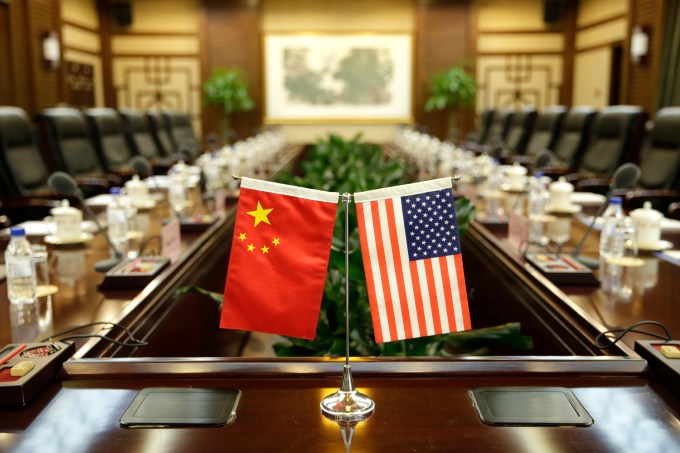
China and the U.S. are progressively battling a worldwide fight for tech authenticity (Photo by Jason Lee/AFP/Getty Images)
That foundation is once in a while streets, however it can likewise be in territories like broadcast communications. Huawei has made gigantic advances into Africa, both in cell phones and in center foundation. Chinese-possessed Transsion, which most Westerners have presumably never known about, is the prevailing cell phone maker on the mainland.
Chinese-made telecom foundation. Chinese handsets. Progressively Chinese applications. For the majority of the worries of Congress and national security authorities about Huawei and ZTE gear entering the American or Australian markets, the genuine battle for the fate of the web will be in unequivocally these creating districts which have no officeholder innovation.
That is the thing that has made the Trump organization's procedure toward exchange transactions with China so hopeless to watch. The emphasis has been on rehashed rounds of levies that will guarantee that Chinese merchandise — especially in innovative enterprises — are more costly to American shoppers, enabling residential producers to all the more likely contend. However, the approaches have done nothing to guarantee that American qualities around the web are sent out to mainlands like Africa or South America, or that Cisco's hardware will be picked over Huawei's.
That may change finally. The Financial Times announced yesterday that the Trump organization is planning to twofold down on the Overseas Private Investment Corporation, which offers business loaning offices to creating nations. It would be converged into another office and given a considerably more rich spending plan (as high as $60 billion) to run and contend with Chinese financing far and wide.
Possibly that measure will be fruitful in shutting the key separation between the two nations. Perhaps bits of gossip that the organization is going to extensively twofold down on the exchange war will prompt a significantly more far reaching set of arrangements.
In any case, en route, paying little heed to what occurs, these encounters will prompt a breaking of the web, and alongside it, the demise of the web as a bastion and voice of opportunity and information for all individuals all over the place.

0 Comments